
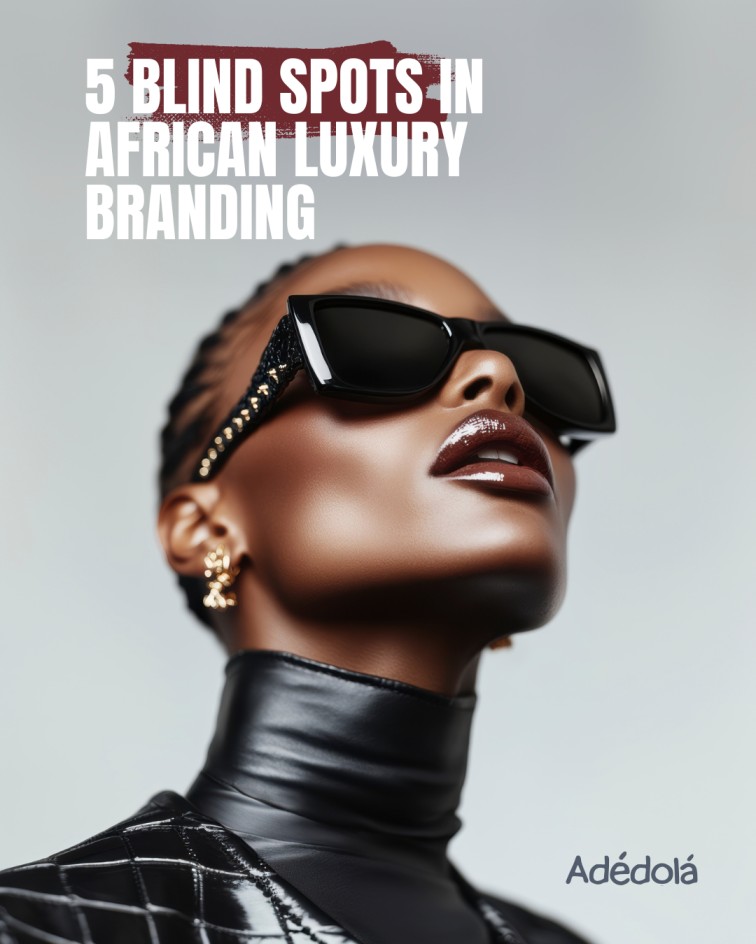
There is a certain confidence with which African brands have stepped into the language of luxury. Prices rise, campaigns become more elaborate, fabrics feel richer, and there is a sense that the continent is finally taking up space in a global industry that once ignored it. From Lagos to Johannesburg to Accra, you see brands describing themselves as luxury houses, ateliers, heritage custodians. On the surface, it is exciting. The work is often beautiful. The ambition is real.
Yet when you move past the images and actually interact with the brands, another story begins to emerge. The product may be strong, yet the experience surrounding it is uneven. The language is elevated, yet the systems beneath it are fragile. Luxury is claimed, but it is not consistently felt. And the tension is not in creativity, because African creativity has never been in question. The tension is in the invisible parts of the brand that most people never see, but every customer feels.
Luxury is not your price point. It is the experience wrapped around the product.
That experience is held up by things that are rarely discussed in public. The invisible systems that shape trust. The decision making logic that quietly forms a brand's identity. The gap between what luxury customers expect and what many teams are equipped to deliver. And the reality that African brands are trying to scale on foundations that were never fully built. They are blind spots that live in the backstage of the brand, and they determine whether luxury feels believable or performative.
After building DỌLA and walking closely with founders through Adédọlá Consulting, I have seen the same patterns repeat themselves across different sectors and price points. The product keeps improving, but the experience around it does not always keep pace. In that gap, opportunity leaks away. Investors hesitate, customers hold back, and brands struggle to grow beyond personality and proximity.
There are five patterns I see across many African luxury brands, and each one has the power to move the entire sector forward if we are willing to rethink what luxury truly requires.
1. Consistency as a luxury standard
One of the biggest blind spots in African luxury is the assumption that exceptional moments are enough to sustain a premium brand. Many founders pour remarkable effort into the campaign, the pop up, the show, or the one viral look. The problem is that luxury is not held up by peaks. It is held up by rhythm. It is the quiet repeatability of quality, communication, packaging, and delivery that makes the customer feel safe. Without that rhythm, a brand becomes memorable for its talent but unreliable in its experience.
You see this in small, almost invisible ways. A product arrives beautifully packaged one month, then casually wrapped the next. A team replies instantly to one customer, then takes two weeks to respond to another. Measurements shift slightly from one order to the next. Even when the creativity is strong, the inconsistency tells a different story. It tells the customer that the brand is still building itself around moments rather than systems.
Globally, luxury customers have been trained to expect predictability. They expect a stable cadence of communication, reliable fulfilment, and a sense that the brand knows itself deeply enough to deliver consistently without improvisation. Consistency is not a constraint. It is an emotional promise that says, you can trust us again.
A stronger alternative requires African brands to treat consistency as a design principle. The same intentionality that goes into a campaign moodboard should be applied to operations. Mapping the customer journey, defining team rituals, training staff weekly, and documenting internal processes are not administrative burdens. They are the scaffolding that allows creativity to stand tall. And as brands mature, consistency becomes one of the clearest signals of luxury.
2. Knowledge and information gaps around materials, construction, and care
Another quiet blind spot lies in how African luxury brands communicate what their products are made of. Customers often have to guess the fabric composition, the durability of plating, the sourcing of stones, or the best way to care for a garment. Labels are missing, incomplete, or inconsistent. Teams rely on what the tailor said or what the supplier promised. Founders know the category well, but that knowledge is rarely translated into customer-facing clarity.
This gap becomes obvious during interactions. A customer asks whether a fabric will bleed, stretch, shrink, or wrinkle, and the team hesitates. Someone purchases a statement piece and is not told how to store it or how often to clean it. A bride receives a custom dress but is not given instructions on how to preserve it. For a luxury customer, this affects how much trust they place in the brand, because premium pricing without premium information feels unbalanced.
Globally, luxury brands invest heavily in educating their customers. It is normal to see detailed care guides, fabric breakdowns, metal explanations, storage advice, and long term maintenance options. High end jewellery houses, for instance, are explicit about karats, plating, stone origin, and aftercare, because they understand that knowledge reduces friction and strengthens loyalty.
The solution is not more jargon. It is clarity. African brands can elevate their experience simply by knowing their materials intimately and communicating that knowledge with confidence. Labels, cards, instructions, and product descriptions should give the customer a sense that they are buying into expertise, not experimenting with uncertainty. When a brand can speak clearly about what it makes, the customer moves from curious to committed.
3. The unsexy internal systems that hold the experience together
Luxury brands often shine publicly while struggling privately. Behind many African luxury brands, you find teams that are stretched thin, working across multiple roles, managing inconsistent suppliers, and navigating the daily unpredictability of production environments. This is not a criticism of effort. It is a recognition of infrastructure gaps that are rarely acknowledged.
Where this becomes a blind spot is in the belief that great products and great storytelling can compensate for fragile systems. They cannot. Systems are unseen, but they are deeply felt. When a customer experiences a delay, a miscommunication, or a production error, it is almost always the result of a broken or informal process. Without structure, even the most talented team will default to survival mode, and survival mode is not where luxury thrives.
Globally, luxury houses run like orchestras. The back end is disciplined. They invest in process, training, vendor relationships, inventory systems, packaging pipelines, and quality control. Customers do not see these systems, but they feel the ease and predictability they create.
For African brands, the alternative is to embrace systems as part of their creative identity. Document how decisions are made. Build internal libraries. Treat quality control as a cultural value. Create templates, scripts, workflows, and rituals that make excellence inevitable rather than occasional. Systems do not restrict creativity. They hold it.
4. Identity beyond aesthetics
Many African luxury brands have strong visual identities. You see it in the colours, logos, textures, moodboards, and photography. The challenge is that visuals often stand in for something deeper. Real identity is not aesthetic. It is decision making logic. It is the inner architecture that dictates how a brand chooses materials, sets boundaries, treats staff, responds to crises, and defines quality.
When identity is rooted only in visuals, the brand becomes fragile. A new photographer changes the tone. A new moodboard shifts the perception. A new team member introduces inconsistency. Without a clear logic guiding the brand from the inside, it becomes easy to drift, to imitate trends, or to rely too heavily on momentary creativity.
Global luxury houses rarely confuse visuals for identity. Their identity is rooted in philosophy, heritage, worldview, values, and a clear internal compass. Visuals are simply the expression of that logic.
African brands can strengthen their identity by documenting their internal logic. What do we value? What do we never compromise on? How do we define quality? How do we treat people? How do we choose materials? How do we communicate? When these decisions are anchored in a coherent logic, the brand becomes clear, not just beautiful. And clarity is a form of luxury.
5. Post purchase experience and long term trust
The last blind spot is the one that determines whether a brand will survive. Many African luxury brands put extraordinary effort into the sale. After the customer pays, the energy shifts. The follow up is inconsistent. Repairs take too long. Alterations are unclear. Replacement policies vary. The customer begins to feel that the relationship was transactional rather than relational.
Luxury customers care deeply about how they are treated after the moment of payment. They expect ease, kindness, clarity, and continuity. Globally, post purchase care is one of the strongest indicators of brand maturity. It is why luxury houses invest in lifetime polishing, complimentary adjustments, seasonal touch ups, and access to experts. They understand that trust is maintained through maintenance, not marketing.
African brands can shift this dynamic by seeing the post purchase experience as part of the product. Aftercare guides, repair options, structured timelines, loyalty rituals, and seasonal check-ins all communicate one thing: we intend to be here for a long time. When a customer feels held beyond the sale, they return without hesitation.
African luxury is rising. The creativity is undeniable. The ambition is remarkable. The world is paying attention. But for the continent to take its rightful place in global luxury, the depth must match the dream. My hope is to invite us to build internally with the same intention we bring to design, to treat systems with the same reverence we give to fabric and form, so the experience a customer meets feels as considered as the product they hold.
Luxury is not your price point. It is the experience wrapped around the product.
And when African brands embrace that truth with clarity and structure, the world will not only watch. It will trust.
At Adédọlá Consulting, this is the work we hold quietly behind the scenes, building brands from story and system, so that their promise has the structure to stand.